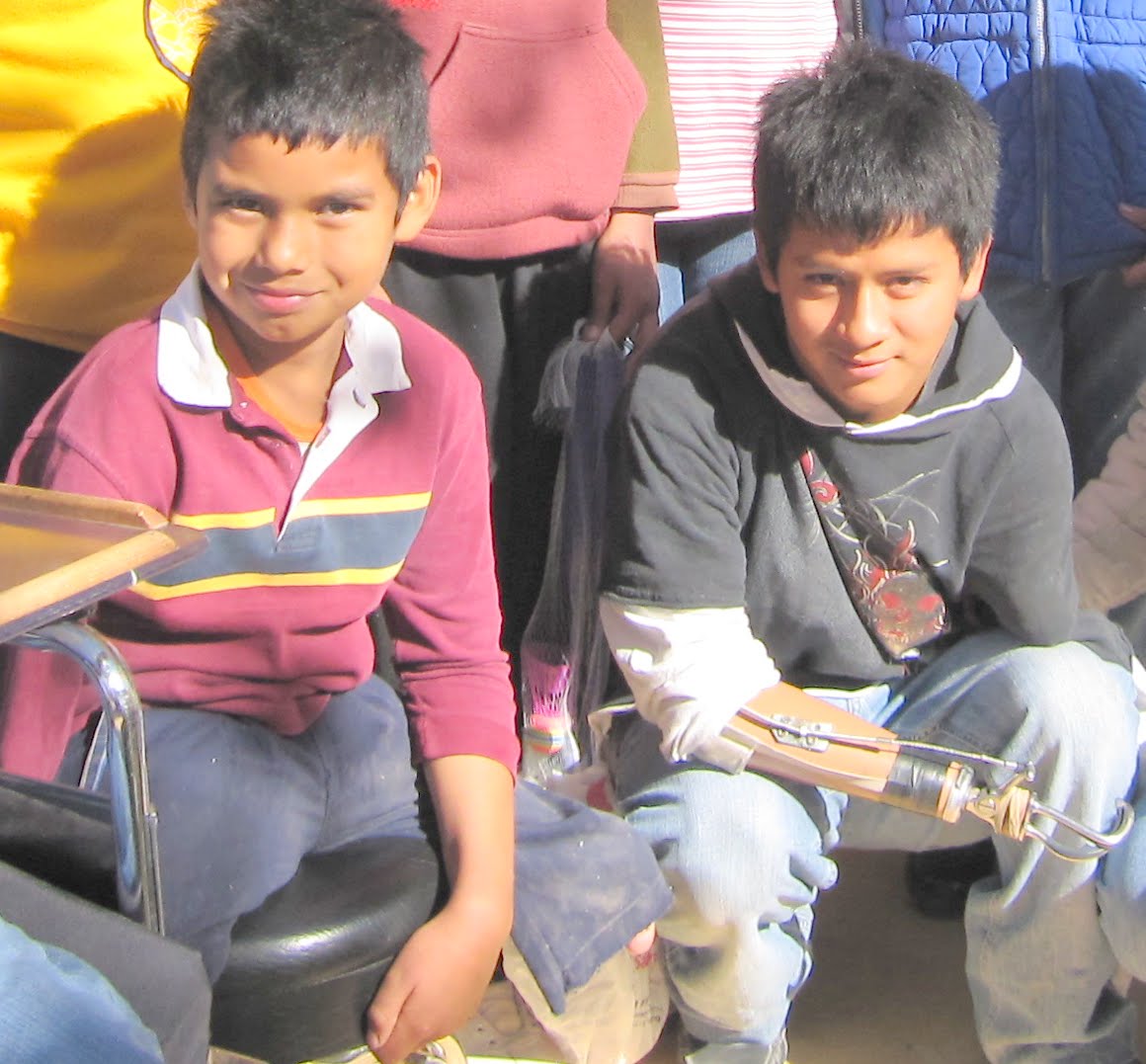
Solar water heaters for the very poor who cannot afford propane proved critical during last winter’s 1 degree low. We use the steel inner tank from used water heaters, place it in an insulated crib, cap it with a plexi-glass lid and forever, hot water without cost, so important for our good folks. The photo shows the simple but effective unit. One unit installed, with materials: only $145. Used but suitable inner tanks are hauled from Utah by Rotarian Ralph Bair. Installation labor is provided by our WoA team.
Electricity is unavailable to thousands. Because the high desert skies are sun-drenched and clear, we are promoting individual solar electric generation. We have installed a prototype on the roof of a special friend, blind musician Esteban, who is employed by the town’s water company. Esteban is very bright and well-educated. He is able to describe to neighbors how the system works. He encourages them to save for the opportunity. If they can save $275 (the cost), we will install the system for them. In the photograph is Fred Berthrong, of Logan, Utah Rotary, a retired Navy nuclear engineer. He bought and installed the first system. If donations arrive for more electric systems, our team will install them.
EMT Training Brings Lifesaving to Sonoran Highways
Mexican highways are narrow and dangerous, but unknown to most travelers is that no emergency support is available, no first responders will appear. In November 2007, Director of the Technical University Domingo Trujillo, his wife, and three teenaged daughters were driving home from Juarez along the Mexican highway to Agua Prieta. A terrible accident happened. The three girls were badly injured, two dying in the ambulance dispatched to the scene from Agua Prieta. The ambulance was only a van painted as an ambulance without equipment and the Cruz Roja team were not trained. Wings of Angels has responded to this and similar tragedies by partnering with a Douglas fire fighter and Arizona and Utah Rotary clubs to provide first-rate EMT training and ambulances for the region.
The Top 10 Things an EMT needs to know:
1. Scene and personal safety
2. Airway management and oxygen therapy
3. Patient assessment
4. Bleeding control and shock management
5. Soft tissue injuries and burns
6. Cervical spine injury management
7. Fracture management
8. Head injury management
9. Special populations (the elderly and children)
10. Special operations (extrication, hazardous materials, incident command, triage)
-- From the EMT training program
EMT TRAINING IN ACTION
by Captain Manny Ayala, Captain
Douglas, Ariz. Fire Dept.
August 8, 2009
Last year we completed the EMT class in Agua Prieta, Sonora. Sixteen people graduated from this class; they received the same training an EMT would receive in the United States. Thanks to the City of Hyrum, Utah and the Arizona Department of Health Services, we were able to donate two ambulances to the Agua Prieta Cruz Roja volunteers. In addition, through the generosity of Wings of Angels Foundation, we purchased personal medical equipment for each one of these students, which was presented during their graduation ceremony. Quite honestly, I had my doubts about how much of an impact we would have on the EMS system in Agua Prieta. I had already trained about 40 EMT's from all over the state of Sonora, but most of them had left Cruz Roja before passing on their skills and knowledge. In addition, Cruz Roja would not recognize them as EMT's, since their system allowed only EMT'S trained in Mexico City to be certified.
On July 5th of this year, while off duty, I received a call from Mario Novoa, Douglas Fire Chief. He reported he had received information about an accident in Mexico with multiple patients. The person who called him advised him to expect about 18 critical patients coming into Douglas. Given my relationship with Cruz Roja, he asked if I could help coordinate the transport and care for these patients.
I responded to the Douglas Fire Department and started calling Cruz Roja for additional information. I was told the accident involved a head-on collision between two vehicles, with two adult fatalities on scene and approximately 11 children injured, some critically. Fortunately, we learned that only three patients would be coming to Douglas.
We dispatched units to the port of entry. After all the children were transported, my DFD coworkers told me that all of those patients were properly immobilized, had IV's in place, their wounds were properly managed, and shock prevention measures were in place. Happy to report, to the best of my knowledge, all three survived without any permanent damage. We must have taught them something right!
On Sunday, August the 2nd, while on duty, I was notified by Cruz Roja of another accident with multiple fatalities and injuries. This time it was a collision between an SUV and a semi trailer. After the collision, both vehicles went off the road, and the trailer landed on top of the SUV. I saw the pictures in the AP newspaper, and they were horrific. They advised they would be bringing two teenagers with critical head injuries to the US. Again, both of these patients (a 14-year-old boy and a 17-year-old girl) were properly immobilized, had IV's in place, and even better, they had both been intubated. Both were receiving proper oxygenation. And, best of all, all the volunteers were wearing gloves and other personal protection equipment. Something else that surprised me: a female doctor was in the ambulance with the 14-year-old boy. She gave me a very professional and complete report on the patient's status and treatments he had received. I do not know if these patients survived. One newspaper said the girl died, another said the boy died, and a third newspaper said they both died.
I had an opportunity to talk to the Cruz Roja volunteers after the fact, and they told me that since they started implementing advanced trauma procedures, the doctors are more respectful of their work, and are more willing to help them. For the longest time, ambulance volunteers were seen by Mexican doctors as nothing more than patient loaders and transporters. Conflicts between the two sides were frequent, and if any Cruz Roja volunteers attempted any advanced procedures, they were promptly threatened with legal action for "practicing medicine without a license." I know; I lived through that era. Now doctors are accompanying patients during transport, riding in the ambulance, stopping to render aid at the scene of the accidents, and helping train the volunteers.
Later that same day, we were called again to the port of entry. A teenager from Douglas was involved in a rollover in Agua Prieta, and he had critical head injuries. Again, the patient was properly immobilized, treated, intubated, and a different doctor was in the ambulance with him. Unfortunately, his injuries were so severe that they were non survivable, and he died shortly after being transported.
As you can see, the training program that you helped put together has not only saved lives. It has helped change old attitudes towards the ambulance volunteers. It has motivated more people to do more things for those who suffer injuries. These changes were long overdue, and although they are happening very slowly, THEY ARE HAPPENING. The ones who will benefit are the patients who find themselves in need of these services.
EMT Advanced Training/Cardiac Intervention, June 11, 2011
61 EMT’s and bomberos representing Cananea, Esqueda, Huachinera and Agua Prieta attended Captain Manny Ayala’s presentation
Continuing progress for emergency care
In cooperation with the Douglas Fire Department and Arizona and Utah Rotary Clubs, we are forming Mexico’s first Urgent Care Center to serve the little villages and towns within the remote Sierra Madre, all which have access to the town of Huachinera (founded in 1650) at the epicenter of the region. We have the support of the town mayor, a doctor has signed on and Logan Utah Rotarians have donated an ambulance. Several of the recently trained EMT’s will sign up to serve there.
~~~~~~~~~~~~
Sonoran Crisis Intervention Clinic
Now in its thirteenth year, continues to provide monthly services for those not cared for by any other agency or group. We are popular throughout the region and receive patients from as far away as seven hours because others have assured them that Wings of Angels will help them. They arrive in great anticipation and we give them support and comfort. Our Medical Director is an experienced nurse practitioner with previous service in Yemen and the Navajo Reservation. She has seen everything, and fits right in.
We are able to provide so many things missing from the culture of the poorest in Mexico because we have a competent, skilled core which has been together for more than ten years. We are able to do this on an annual budget of $35,000. As you know all the US participants are volunteers. Our donors are thrilled to participate. If you are able to support us in any way, not a cent is ever wasted.
Angels Foundation
EIN: 860989829
1552 12th Street,
Douglas, AZ 85607
364-5176
602-326-0057- c
Wings of Angels Foundation
The mission of Wings of Angels Foundation is to rescue, stabilize and transform the more-than-poor border families, in Agua Prieta alone 40,000, and Northern Sonora, Mexico. For more information see wingsofangelsfoundation.org
Saturday, August 20, 2011
Tuesday, August 10, 2010
WOA Foundation
Our belief is to Rescue, Stabilize and Transform the poor and more-than-poor of northern Sonora who are not being served by any agency or group. We are located in Agua Prieta, Sonora, Mexico, a very poor border town of 200,000 across from Douglas, Arizona. Since 2000, the Wings of Angels Crisis Intervention Clinic in Agua Prieta has held 115 consecutive monthly clinics (10,000 patient visits) staffed by volunteers, medical doctors and nurses who provide medical and dental treatment, administer care and deliver medications, arrange surgeries, provide glasses, prosthetics and orthotics, provide family counseling and mentoring, formulated milk, diapers, physical therapy and equipment, wheelchairs, blankets, fresh produce from the Wings teaching garden, support for education, and winterized shelters. To understand the lifestyle of the poor and more-than-poor it is helpful to read the somewhat shocking descriptions below.
The Poor: A poor border family consists of a reasonably whole unit with mother, father, a grandparent, and several children. Good family values are generally in place. The father has a job and makes $50-$70 a week. The family has water, an outside toilet, perhaps electricity or several lights and a television,sometimes powered by a car battery. The diet is principally flour tortillas, beans and rice with intermittent additional food sources. (With this diet, the incidence of Type II diabetes is high). The family does not own a car. The children go to school until the cost of books and uniforms prevents their attendance. The adult members of the family have been educated, generally through junior high, while living in the Mexican interior. The number of poor in Agua Prieta is estimated to be 42,000.*
The More-Than-Poor: In the second category, the more-than-poor, the family unit is haphazard, and can include death, orphans, and serious physical or mental limitation. The living environment does not protect from desert heat or freezing winter temperatures. The food supply is intermittent. No one in the family is employed. Family members may engage in crime, drugs and delinquencies. There is no support for school attendance or achievement. There is no electricity or propane to preserve or cook foods. There is no knowledge or awareness of helpful resources in the community. There is no medical support. There is no nutritional support for mental and physical ability to work. The number of more-than-poor is estimated to be 42,000.*
*These figures and category descriptions are cited by Juan Dominquez, Executive Director, DIF (all PAN government social programs), Agua Prieta, 2003-2006
The More-Than-Poor: In the second category, the more-than-poor, the family unit is haphazard, and can include death, orphans, and serious physical or mental limitation. The living environment does not protect from desert heat or freezing winter temperatures. The food supply is intermittent. No one in the family is employed. Family members may engage in crime, drugs and delinquencies. There is no support for school attendance or achievement. There is no electricity or propane to preserve or cook foods. There is no knowledge or awareness of helpful resources in the community. There is no medical support. There is no nutritional support for mental and physical ability to work. The number of more-than-poor is estimated to be 42,000.*
*These figures and category descriptions are cited by Juan Dominquez, Executive Director, DIF (all PAN government social programs), Agua Prieta, 2003-2006
Tuesday, August 3, 2010
Thursday, July 29, 2010
Rescue, Stabilize and Transform
I am a volunteer with Wings of Angels Foundation and I attended a clinic they held in 2005. That day a boy came to the clinic without arms. His father brought him from Vera Cruz because someone told him Wings of Angels would help him. I leapt to my feet and called out "….this one is mine".
Martin was playing on a roof carrying a long metal post. Suddenly the electrocution happened, searing his arms and exiting through a leg at the knee. Neighbors rushed to help but it was fifteen minutes before the power was disconnected. As the host of many dramas to come, Martin somehow lived through this event. He was rushed to Vera Cruz were surgeon Dr. Maximilliano Chimalpopoca did procedures to save his life and what was left of his functioning body. How was it that this child could endure the devastating pain?
Xrays provided information about where arteries were sound in each arm and it was at that point the burned limbs were removed. The doctor thoughtfully provided a Power Point presentation for subsequent medical personnel to have full knowledge of the case.
The child survived and returned home. Another life blow hit as the mother abandoned any interest in the child and left the home. The father, Martin Choncoa, was to rise as the indefatigable hero. Calling for help from his friends Rafael and Claudia, far away in Agua Prieta, Sonora, Martin and his father made the 36-hour bus trip. They were received warmly. Claudia soon began schooling Martin in daily classes although Martin could not hold a pencil or write. The senior Martin, fighting daily tears, searched for help and found it from the town's young physical therapist Fernando Vasquez. In his call to us, Fernando said "this is the last patient you will receive tonight and he is the most important patient you will ever treat. Please do not leave without seeing him. We will be there shortly."
Collecting our wits, we formed a plan. The first support would come from Sander Nassan, founder and benefactor of Prosthetics, Orthotics, Associates (POA) of Scottsdale, Arizona. Martin's trip to Phoenix would be an all-in-one, preparing and fitting a mechanical arm. Octavio Torres, teen son of the Wings of Angels Sonoran Crisis Intervention Clinic Director asked to travel with Martin and introduce him to what life is like in the US for a kid. They had carte blanche at the hotel which provided a free room, a credit card for video games Martin played with his feet, and at night all-you-can-eat at Red Lobster or Chili's or Olive Garden.
Next, it was necessary to treat the damage done by the exiting current. His leg was locked at 45 degrees. Monte Hessler, chiropractor and trainer for the San Francisco Giants, took a look at the leg and recruited plastic surgeon Dr. Ian Parker and the Specialty Surgical Center to repair the problem, all donated services. A nurse confided to us that during recovery Martin called out again and again for his mother.
Monte took his friendship for Martin a step farther and asked third baseman Pedro Feliz to welcome Martin and Octavio to the Giant's bench on game night. Carlos Chavez of the Arizona Republic filmed that event and the surgery. By this time Martin was attaining fame in Phoenix as newspapers acclaimed this kid's spirit and the generosity of local surgeons, the surgical hospital and the skilled prosthesis expert who built Martin's mechanical arm.
Time went by. Martin entered school and had no difficult participating. He won student of the year and a little scholarship. Now that the leg was normal, he could run and play soccer.
Martin senior became a reliable worker within the Agua Prieta municipal workforce and established such a relationship that he and his son received a tiny (140sf) full-service home as a part of the municipal plan to place especially deserving residents in suitable homes. Wings of Angels added 400sf more.
Then the world collapsed. Martin entered a deep depression as his teen boy hormones raced and he said "no woman will ever love me because I do not have arms…" This went on and on and we were very concerned yet quite helpless. We established the Saturday Art Class for disabled children and adults, in part to prepare Martin for a possible future in architecture or engineering. His first art (enhanced by the artist and class instructor Abel Verdin) was sold after many escalating offers to purchase were considered. One Saturday morning turning the corner to the art class, I spied Martin necking with a girl outside. I cheered, the black days were over!
Fast forward: Martin joined the Youth group at a local Catholic parish and sings in the choir. He earned a scholarship for high school, and announced to El Imparcial, the local newspaper, that he was planning a career in architecture. Scholarships for this endeavor (three years out) will surely flood in for this magnificent child who has brought us years of nearly inexpressible joy.
Martin was playing on a roof carrying a long metal post. Suddenly the electrocution happened, searing his arms and exiting through a leg at the knee. Neighbors rushed to help but it was fifteen minutes before the power was disconnected. As the host of many dramas to come, Martin somehow lived through this event. He was rushed to Vera Cruz were surgeon Dr. Maximilliano Chimalpopoca did procedures to save his life and what was left of his functioning body. How was it that this child could endure the devastating pain?
Xrays provided information about where arteries were sound in each arm and it was at that point the burned limbs were removed. The doctor thoughtfully provided a Power Point presentation for subsequent medical personnel to have full knowledge of the case.
The child survived and returned home. Another life blow hit as the mother abandoned any interest in the child and left the home. The father, Martin Choncoa, was to rise as the indefatigable hero. Calling for help from his friends Rafael and Claudia, far away in Agua Prieta, Sonora, Martin and his father made the 36-hour bus trip. They were received warmly. Claudia soon began schooling Martin in daily classes although Martin could not hold a pencil or write. The senior Martin, fighting daily tears, searched for help and found it from the town's young physical therapist Fernando Vasquez. In his call to us, Fernando said "this is the last patient you will receive tonight and he is the most important patient you will ever treat. Please do not leave without seeing him. We will be there shortly."
Collecting our wits, we formed a plan. The first support would come from Sander Nassan, founder and benefactor of Prosthetics, Orthotics, Associates (POA) of Scottsdale, Arizona. Martin's trip to Phoenix would be an all-in-one, preparing and fitting a mechanical arm. Octavio Torres, teen son of the Wings of Angels Sonoran Crisis Intervention Clinic Director asked to travel with Martin and introduce him to what life is like in the US for a kid. They had carte blanche at the hotel which provided a free room, a credit card for video games Martin played with his feet, and at night all-you-can-eat at Red Lobster or Chili's or Olive Garden.
Next, it was necessary to treat the damage done by the exiting current. His leg was locked at 45 degrees. Monte Hessler, chiropractor and trainer for the San Francisco Giants, took a look at the leg and recruited plastic surgeon Dr. Ian Parker and the Specialty Surgical Center to repair the problem, all donated services. A nurse confided to us that during recovery Martin called out again and again for his mother.
Monte took his friendship for Martin a step farther and asked third baseman Pedro Feliz to welcome Martin and Octavio to the Giant's bench on game night. Carlos Chavez of the Arizona Republic filmed that event and the surgery. By this time Martin was attaining fame in Phoenix as newspapers acclaimed this kid's spirit and the generosity of local surgeons, the surgical hospital and the skilled prosthesis expert who built Martin's mechanical arm.
Time went by. Martin entered school and had no difficult participating. He won student of the year and a little scholarship. Now that the leg was normal, he could run and play soccer.
Martin senior became a reliable worker within the Agua Prieta municipal workforce and established such a relationship that he and his son received a tiny (140sf) full-service home as a part of the municipal plan to place especially deserving residents in suitable homes. Wings of Angels added 400sf more.
Then the world collapsed. Martin entered a deep depression as his teen boy hormones raced and he said "no woman will ever love me because I do not have arms…" This went on and on and we were very concerned yet quite helpless. We established the Saturday Art Class for disabled children and adults, in part to prepare Martin for a possible future in architecture or engineering. His first art (enhanced by the artist and class instructor Abel Verdin) was sold after many escalating offers to purchase were considered. One Saturday morning turning the corner to the art class, I spied Martin necking with a girl outside. I cheered, the black days were over!
Fast forward: Martin joined the Youth group at a local Catholic parish and sings in the choir. He earned a scholarship for high school, and announced to El Imparcial, the local newspaper, that he was planning a career in architecture. Scholarships for this endeavor (three years out) will surely flood in for this magnificent child who has brought us years of nearly inexpressible joy.
The Hermosillo Mother’s Club
The ladies from Hermosillo began arriving with their disabled children at our monthly clinic in August, 2009. It is a five-hour trip. They asked for our help because friends told them we would give their children the best care. Manuelito was not able to hold up his head on his first visit and Jesus Angel was a limp little boy cradled in his mother's arms.
Our founder and physical therapist, Marge Conroy, designed special therapies for each child. And, she was able to send them home with extraordinary pieces of therapy equipment provided by Denver medical vendors and hauled four times a year to us by Ron Becker, our engineer and board member. With the new training and equipment, the mother’s were able to form their own group in Hermosillo. They baby sit for one another and have learned the therapy regimen for each child.
The Hermosillo Mother’s are sophisticated and can take advantage of materials available in a more cosmopolitan environment. This program is a fine example of propagation wherein the initial training of the tasks to be accomplished are taught, followed by spontaneous, creative expansion.
Our founder and physical therapist, Marge Conroy, designed special therapies for each child. And, she was able to send them home with extraordinary pieces of therapy equipment provided by Denver medical vendors and hauled four times a year to us by Ron Becker, our engineer and board member. With the new training and equipment, the mother’s were able to form their own group in Hermosillo. They baby sit for one another and have learned the therapy regimen for each child.
The Hermosillo Mother’s are sophisticated and can take advantage of materials available in a more cosmopolitan environment. This program is a fine example of propagation wherein the initial training of the tasks to be accomplished are taught, followed by spontaneous, creative expansion.
Tuesday, July 27, 2010
The Angel Treasure
| Angel and Martin at Art Class |
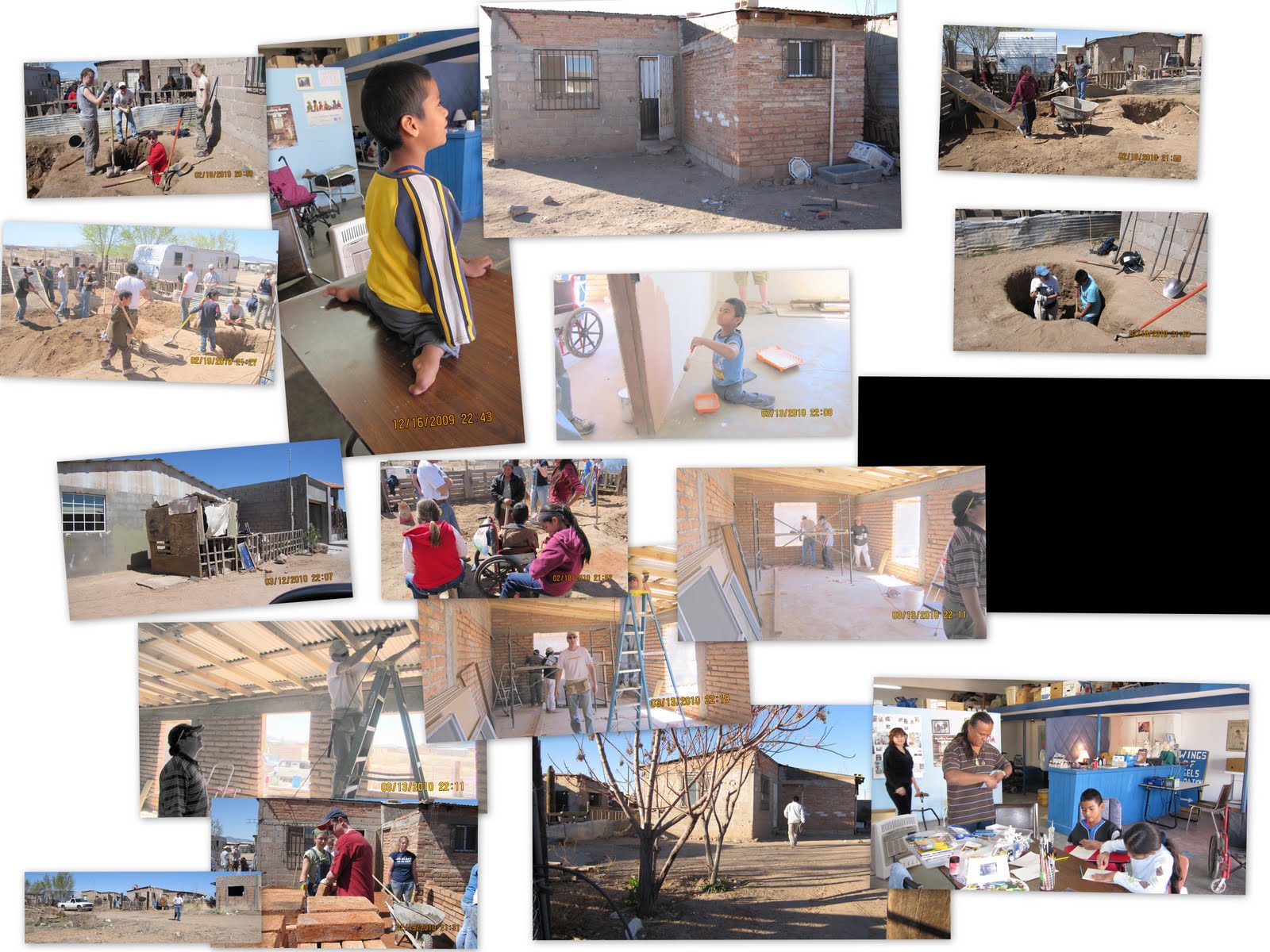
He lives with his mom Alicia, two sisters Nora and Edith, two brothers Florentino and Jesus, and his grandmother Alexandra, (72) and great-grandmother Maria (90). They recently lost their house due to an unwise decision made by the father to borrow $7000 against the property. The creative grandmother, realizing the equity remaining in the property transaction, asked for and received a partially built two-room home located on the outskirts of Agua Prieta, an undeveloped area without water or electric services for everyone. There are two rooms, a bathroom, and a very large yard. Before the project start, we secured a firm title in the name of the grandmother and Angel.
Every year since 2005, the Rotaract (college) and Interact (high school) Rotary Clubs of Logan, Utah, raise money to build a home for a deserving yet desperate family here in Aqua Prieta. Their drive is nineteen hours, their work is scheduled for three days, and their return home begins at mid-point on day four. The crew is directed by Wings of Angels Mexican constructor Marcelino Enriquez. Work began in April, 2010. A large main room was constructed including electric wiring and plumbing for the future services which are expected. Alicia is an avid gardener and half of the site was tilled and prepped. Gutters (prepared in Logan) run around the roof collecting rain water in tanks for irrigation and use in the toilet.
In early summer the family moved into their new home. Alicia noticed the cool interior temperature. (We include insulation and dry wall under the tin roof in the houses we prepare which is not a standard practice in Mexico). Alicia has chilies, chard, and squash growing. A special low window in the new room enables Angel to see everything happening outside from his wheelchair. And Angel has a table garden for his personal use. A new concrete path allows his easy access.
As you may remember, we created a Saturday Art Class for Martin, Esther who suffered a stroke at 13, and others including adults with disabilities. Martin is learning design and drafting techniques to pursue a career either in engineering or architecture. Angel is especially good at mathematics and may follow Martin in a similar career. Martin and Angel have become very good friends and we expect Martin to guide Angel through the more difficult days to come as a teenager. It is breathtaking to remember that between the two of them they share one arm and two legs, precious and invincible, and a great example for those with a tendency to whine and not enjoy life at any age.
____________________________
The collage shows the original house (top and bottom center), preparing the garden soil and cesspool, Angel painting his bedroom, the “school room” he and his friends America and Melissa built for themselves (middle left). Melissa teaches the other two eight-year-olds English. Inside the new great room Jeff Larsen of Logan, Utah Rotary, leads the build-out crew of college Rotarians. Lower right we see Angel and his sister Edith at the Wings of Angels Saturday Art Class.
Saturday, July 11, 2009
We Can Fix Almost Anything...!
Two women have been touched by an angel—or rather, by Wings of Angels—in the tiny rural community of Fronteras, about 30 miles south of the Arizona border. The help they received already has begun to lift them out of the poverty and limited opportunities they have faced for years. One woman was gifted a new hearing aid and the other, crippled by arthritis, received a motorized wheel chair.
The hearing aid for Myrta Teresa Rico Armenta, age 38, has enabled her to move from a factory assembly line to a new office job more compatible with her education and skills. Myrta has suffered progressive hearing loss since age 8, when she was hit by a car and dragged down the street by the vehicle, lacerating her left ear and the side of her face. At age 12, her hearing deteriorated further when she contracted meningitis.
Because Myrta wasn't born with a hearing impairment, she didn't have a speech impediment. Since she could read lips, too, few suspected her disability, which she worked mightily to hide because of rampant job discrimination in Mexico. Myrta worked for years as a secretary in an Agua Prieta office, struggling to save the $1,800 doctors said she needed for a hearing aid. Myrta's hearing worsened during her employment, however. It was eventually discovered by her supervisor, who then harassed Myrta into quitting her job. When her husband lost his job shortly afterward, the two were forced to jump the border, working illegally in Willcox, Arizona, harvesting tomatoes.
But even this seasonal work evaporated when Myrta's passport and visa were stolen during the couple's return visit to Mexico. Without these documents, Myrta couldn't go back to her job in Willcox. Myrta's husband wouldn't leave without her. He works odd jobs in Agua Prieta when he can find them, hoping something permanent will come along soon.
With no job, no income, and her hearing steadily worsening, Myrta's future would have been bleak if her mother hadn't fortuitously been the president of a women's cooperative in Fronteras which was formed to create jobs in their impoverished community. The group gave Myrta a job in the town's only factory, dismantling obsolete computers and other electronics for recycling and resale (see Myrta at http://tv.azpm.org/kuat/segments/2009/7/7/kuat).
Now that she has a new hearing aid, Myrta also has a new job. She has moved across the street from the factory to the office of the local cattlemen's association, where she does secretarial tasks and runs the town's internet café. Myrta can't stop saying "thank you" for the opportunities that have opened up now that she can hear.
Compared to Myrta, opportunities for Maria del Refugio Zamora Sánchez (called "Cuquis" by her friends) were even more limited. The 59-year-old has been crippled for years with arthritis, worsening to the point where she became wheelchair-bound. Even with her twisted hands and her inability to stand, Cuquis made tamales and tortillas for sale in the local mom-and-pop stores. She also sold phone cards and Avon products to the neighbors.
Cuquis' husband Antonino grew alfalfa in his small farm plot. He delivered his wife's tamales and tortillas to customers when he wasn't in the field. He also wheeled Cuquis around Fronteras from door to door so she could collect money from her Avon customers each month. Soon, however, Cuquis began needing regular trips to medical clinics in Agua Prieta to deal with her progressing arthritis. Antonino had to sell his field so he could buy a minivan for the one-hour trip up the highway with Cuquis and her wheelchair.
When Cuquis learned about the Wings of Angels clinic last month, she was praying for a motorized wheelchair so her husband wouldn't have to push her through the streets of Fronteras. If she could get around on her own, she reasoned, Antonino would be freed up to find work. This was especially critical now that he had no field to generate the income needed to pay gasoline and maintenance bills for the minivan.
The $2,000 wheelchair Cuquis needed was beyond her economic reach. The one available at Wings of Angels was perfect for her, but it had no batteries. If Cuquis could come up with the $200 for the golf-cart-type batteries, she was told, the chair was hers. Cuquis didn't have the money but was undeterred. Within two days, she had so moved her congressman that he paid for the batteries out of his own pocket, on the condition that she pick them up in Douglas, Arizona, where they were purchased.
Cuquis and Antonino went in their minivan and got the batteries, then showed them to the folks at the clinic. They were promptly installed in the wheelchair which the couple gratefully took back to Fronteras. The neighbors say Cuquis is rarely home now. She is always tooling around town, plying her tortillas and tamales, collecting on her Avon sales, and going to church every morning. Antonino has found odd jobs in the local cornfields and on nearby ranches. Now that Cuquis can move around independently, she can't stop smiling. But Cuquis will tell you she doesn't ride a wheelchair. She's carried everywhere, she says, on Wings of Angels.
The hearing aid for Myrta Teresa Rico Armenta, age 38, has enabled her to move from a factory assembly line to a new office job more compatible with her education and skills. Myrta has suffered progressive hearing loss since age 8, when she was hit by a car and dragged down the street by the vehicle, lacerating her left ear and the side of her face. At age 12, her hearing deteriorated further when she contracted meningitis.
Because Myrta wasn't born with a hearing impairment, she didn't have a speech impediment. Since she could read lips, too, few suspected her disability, which she worked mightily to hide because of rampant job discrimination in Mexico. Myrta worked for years as a secretary in an Agua Prieta office, struggling to save the $1,800 doctors said she needed for a hearing aid. Myrta's hearing worsened during her employment, however. It was eventually discovered by her supervisor, who then harassed Myrta into quitting her job. When her husband lost his job shortly afterward, the two were forced to jump the border, working illegally in Willcox, Arizona, harvesting tomatoes.
But even this seasonal work evaporated when Myrta's passport and visa were stolen during the couple's return visit to Mexico. Without these documents, Myrta couldn't go back to her job in Willcox. Myrta's husband wouldn't leave without her. He works odd jobs in Agua Prieta when he can find them, hoping something permanent will come along soon.
With no job, no income, and her hearing steadily worsening, Myrta's future would have been bleak if her mother hadn't fortuitously been the president of a women's cooperative in Fronteras which was formed to create jobs in their impoverished community. The group gave Myrta a job in the town's only factory, dismantling obsolete computers and other electronics for recycling and resale (see Myrta at http://tv.azpm.org/kuat/segments/2009/7/7/kuat).
Now that she has a new hearing aid, Myrta also has a new job. She has moved across the street from the factory to the office of the local cattlemen's association, where she does secretarial tasks and runs the town's internet café. Myrta can't stop saying "thank you" for the opportunities that have opened up now that she can hear.
Compared to Myrta, opportunities for Maria del Refugio Zamora Sánchez (called "Cuquis" by her friends) were even more limited. The 59-year-old has been crippled for years with arthritis, worsening to the point where she became wheelchair-bound. Even with her twisted hands and her inability to stand, Cuquis made tamales and tortillas for sale in the local mom-and-pop stores. She also sold phone cards and Avon products to the neighbors.
Cuquis' husband Antonino grew alfalfa in his small farm plot. He delivered his wife's tamales and tortillas to customers when he wasn't in the field. He also wheeled Cuquis around Fronteras from door to door so she could collect money from her Avon customers each month. Soon, however, Cuquis began needing regular trips to medical clinics in Agua Prieta to deal with her progressing arthritis. Antonino had to sell his field so he could buy a minivan for the one-hour trip up the highway with Cuquis and her wheelchair.
When Cuquis learned about the Wings of Angels clinic last month, she was praying for a motorized wheelchair so her husband wouldn't have to push her through the streets of Fronteras. If she could get around on her own, she reasoned, Antonino would be freed up to find work. This was especially critical now that he had no field to generate the income needed to pay gasoline and maintenance bills for the minivan.
The $2,000 wheelchair Cuquis needed was beyond her economic reach. The one available at Wings of Angels was perfect for her, but it had no batteries. If Cuquis could come up with the $200 for the golf-cart-type batteries, she was told, the chair was hers. Cuquis didn't have the money but was undeterred. Within two days, she had so moved her congressman that he paid for the batteries out of his own pocket, on the condition that she pick them up in Douglas, Arizona, where they were purchased.
Cuquis and Antonino went in their minivan and got the batteries, then showed them to the folks at the clinic. They were promptly installed in the wheelchair which the couple gratefully took back to Fronteras. The neighbors say Cuquis is rarely home now. She is always tooling around town, plying her tortillas and tamales, collecting on her Avon sales, and going to church every morning. Antonino has found odd jobs in the local cornfields and on nearby ranches. Now that Cuquis can move around independently, she can't stop smiling. But Cuquis will tell you she doesn't ride a wheelchair. She's carried everywhere, she says, on Wings of Angels.
Subscribe to:
Posts (Atom)